Showing posts with label Review. Show all posts

Friday, April 15, 2016

About a Long-Lost Love

I want to talk about one of my favorite games of all time. It's a game that, if it was still in production, I'd still be playing to this day:


Chainmail (or D&D Chainmail, as it was known to differentiate it from the proto-D&D miniatures game "Chainmail"), was published by Wizards of the Coast in 2001, and contained some notable alumni in its production: Chris Pramas, Skaff Elias, Adrian Smith, Mike McVey, and Jason Soles to name a few—not to mention all the sculptors you'd no doubt recognize.

So what was so cool about Chainmail? It was effectively D&D 3rd edition turned into a miniatures game. You assembled a warband of figures that generally numbered anywhere between three and seven figures, and you maneuvered and spelled the shit out of each other! It had a really innovative command system, where your commanders could issue orders to troops. Your commanders had a number of command points that they could expend to move their basic troops around and maybe even make them fight a little better. 


It had the perfect mix of casual and competitive rules and attitude that I've not seen matched in any miniatures game since. The rules were such that you could assemble a warband of synergistic models and conduct your battles in a strategic manner similar to what you may see at an X-Wing or Warmachine/Hordes tournament. But if you weren't a competitive gamer, then the sheer amount of scenarios they released—combined with the campaign that was contained in their first supplement—meant that you could play thematic games that focussed on a story.

Really, it still amazes me to this day the sheer amount of scenarios that game contained. By my count there were over thirty at the end of its run in 2003. The scenarios weren't like your typical tournament-focussed scenarios which are largely abstract, gamey, set-ups that you may see in an event's "tournament package" (though the game had these too), but they felt like these would be conflicts in a fantasy world. 


These scenarios were contained in the rulebook and over the course of four supplements. These supplements not only contained scenarios and rule updates, but new rules on environments (fighting in the underdark), new spells your models could learn, and the stats for the new wave of models. They also contained more of the ongoing story about these empires and hordes fighting over the sundered essence of the dead god of war Stratis.

Back in 3rd edition D&D, WotC wanted to focus the setting on the world of Greyhawk. In order to make a miniatures game where there were stakes to the storyline and players' victories they set the game in the Sundered Empire in the western part of the main continent on Oerth, and introduced new characters and factions. 


The models were good too. Some of them were pretty typical of the early 2000s, non-Citadel, quality that you saw among the miniatures spectrum, but it had the best range of gnolls I've ever seen. It also had the coolest owlbear

Anyway, that's really all I wanted to say on the subject. The game's long dead, having been replaced by the pre-painted figures and simpler miniatures game in 2003. I enjoyed that one too, but it was no Chainmail.

+++END TRANSMISSION+++

Monday, January 19, 2015

Of Kings And War

I had a chance to play Kings of War last Sunday. It was the second time I've played this game, and like the first, I was pleasantly surprised.

Here's the scene: A friend of mine has a 12'x4' table, which, as a gamer, is Shangri-La. He also has enough painted undead figures to line up along the length of that 12'x4' table. He invited over myself and another friend to ally against his dread legions. We played 3000pts and it only took us three hours.

This is the major benefit of Kings of War over other regimental games—being Warhammer, as I think the two games are the only regimental games on the market right now—that it's quick. Every time I look at Kings of War I always think it's going to be boring. I will admit, it is a bare-bones system. You move, you shoot, you fight in combat, sometimes you can cast spells—which are fancy (but not that fancy) shooting attacks—but really everything does what you think it's going to do outside of the normal randomness of a dice-based system.

Some (like my friend with the table) look upon this as the highlight of the system, but I look at it as a drawback (albeit one with potential). I like a game system with variance and options. Warhammer has drawbacks, sure, but a dearth of options is not one of them. In Warhammer you have an arsenal of stuff at your disposal, hell even the terrain on the table can give you things to think about other than "I can't see through those trees."

So naturally every time I read up on Kings of War, and set up a game my eyes hurt from rolling in my skull, and my lungs are well stretched from the constant sighing. However the game is super-intuitive and quick. Like I said, a 3000pt game (which is probably 3500–4000pts in Warhammer) played in three hours is unheard of in most miniatures games. Also, I've only read the rulebook once and the gap in time between my two games is most-likely longer than a calendar year, yet it was all in my head.

The game is written by Alessio Cavatore who used to work for Games Workshop, and was the principal author of Warhammer 7th edition. 7th edition was (in my humble opinion) fun, but it was the most ho-hum of Warhammer editions. Sort of a clean up of 6th edition, and a forgettable transition between the kind of game 6th edition created (streamlined tournament-ready system with some of Warhammer's traditional wackiness), and the game Warhammer is now with 8th (which is to say, great). So when I read the rules and saw who authored them, it made sense to me. But now I've developed a whole other respect for Alessio's work (my comments about 7th still standing). I see that what he was trying to create was a fast, simple, and intuitive miniatures system.

Kings of War will not replace Warhammer for me. I won't turn down a game, and I may even tailor an army specifically to the system. I can even see myself entering a Kings of War tournament and being satisfied by the state of the rules while within that medium, but it's not replacing Warhammer. What it is is a solid, fast, big-battles, game that would provide an excellent framework for customizing.

This kind of brings me to an aside: I think all too often (especially now as opposed to in the '70s or '80s) miniatures gamers get hung up on a "tournament ruleset," which is understandable, as it gives us the framework to not only play in tournaments but to facilitate one-off games against strangers in shops, clubs, or conventions. Having a set of house rules is tons of fun and can be pretty creative, but it's also something you need to inform people of when they want to join.

But one of the benefits to tabletop games (versus electronic game, for instance) is that they're malleable. Kings of War is a great example of a game system that provides a solid framework upon which I would love to see stuff added. I would love wackier units to add to my army, and a more robust magic system. Hell, even some interesting scenarios would spice things up. As it stands, the game is a set of vegetables. Good, but it needs something done to it to really be a favorite of yours truly.

Anyway, enough from me, enjoy these, passable, pictures of our game. I thought the lighting in my friend's place was too dark, so I turned on the flash (something I never do on cameras). After I got home and sobered-up (Kings of War also works when you've polished-off seven cans of beer), I immediately regretted my flash decision, and promise that I'll never, ever, do it again...

12' of Undead.

The grand alliance of elves and dwarves (and a
can of Cariboo beer).

Some o' my dwarves.

A rollicking fight in the center of the table.

Generals and gentlemen.

A big ole scrum against some zombies.

My dwarf general vs. a necromancer that the
undead player forgot to do anything with the
whole game (much to my benefit).


+++END TRANSMISSION+++


Monday, December 8, 2014

Warzone's Resurrection


I had my first game of Warzone a couple weeks ago and it was tons of fun!

For those of you who can move your eyes slightly to the right of this text you'll see that Warzone is in my top 3 miniatures games and has been in this position since I started playing it. It's not about to stop just 'cause another version has come out. 

Warzone: Resurrection is the fourth miniatures game to bear the name, and it lives up to its legacy. It's the same as it's always been: d20-based, action points (though with only 2 as standard instead of 3), squad-based, and powered by an alternate-activation system. The major differences to this version are the addition of a customized deck of cards and of save modifiers based on strength and type of weapon/attack. Some armors are more or less susceptible to certain types of weapons, and any strength higher than 10 gives a –1 to a model's save based on how high above 10 it is (i.e. a strength 11 attack gives the target a –1 save, a strength 15 a –5 save, etc in addition to any susceptibilities the armor may have to any weapon fired at it.).

Now the customized deck of cards I have yet to try (my opponent accidentally threw out his cards, so he couldn't build a deck), but I can't say I'm chomping at the bit to do so. The idea with Warzone: Resurrection is that if you want—and I suspect "official" tournaments will make this aspect mandatory—you can build a deck of various cards that will augment your army and/or hinder your opponent's à la Magic: the Gathering (however these cards are not collectible or randomly packaged in case that bugs you—I don't mind either way—and/or was an impediment to your decision to start this fantastic game). 

Here's what I'm talking about: You'll build your own deck of cards before the game. During the game you'll have a hand of cards that you'll be able to play them against your opponent. Even in the "Basic Game" (as the version, sans cards, is known) there are "resource cards" which, when tapped, allow your models to perform more actions (thus giving your models the "missing" 3rd action that 99% of units had in past editions), heal, or add a +1 bonus to hit. In the "advanced game" (as the version with the deck of cards is known) you can tap these resource cards to activate the cards you play from your hand.

I'm super-skeptical about cards in miniatures game beyond simply reference, of course (see Warmachine/Hordes). I think it adds an unneeded complexity to an already complex and customizable game. Not to mention that miniatures games are constantly being revised and errata'd and having to update an extra accessory can become confusing. This has already happened with Warzone, as Prodos (the company producing the game) has announced a set of replacement cards that will, at the time of this article, soon be available.

My opinion is to leave the card game mechanics to card games. You don't always need to put peanut butter in your chocolate. I know this sounds close-minded, or even grognard-ish (really, I'm not!), but I do need convincing whenever I see these two genres mix—and this is from  the mouth of a proud Magic player. Look, I promise that I'll give the "advanced version" a shot with an open mind, but I'm more than happy to stick with the "basic game" indefinitely as it really is the Warzone that I've always loved.

Anyway, if you like 28mm sci-fi games, there's no reason you shouldn't look into this game, after all, it's in my top 3. Here are some pictures of the game I played (and lost...):
My Brotherhood troopers advance on Dr. Diana's clone.

My poor Judicator died because we played the armor piercing rules wrong. You only subtract the "AVV" value of the weapon from the armor save of the vehicle, you don't also subtract the strength modifier.

I painted up an old Inquisitor model from 1st edition Warzone to use as my warlord. In Warzone: Resurrection you can create your own heroes using a set of character creation rules. I haven't named him yet. Those two glass beads are wounds... 

My opponent's Cybertronic troopers. Out of all the factions of the game Cybertronic got the biggest makeover in terms of models, and I couldn't be more pleased with them.

The doom of Squad Primus.
Up next on the painting docket: Brotherhood Inquisitors, Blessed Vestal Laura, and the Capitol starter box (my favorite faction!).

+++END TRANSMISSION+++

Monday, October 29, 2012

Print on Demand: a review whether you like it or not

As I've previously written, White Wolf/Onyx Path (one of my favorite RPG producers) has gone to a "digital first" model. This means that they will publish all their books in pdf first, then produce a print-on-demand (PoD) version of the pdf. Occasionally, they run Kickstarters for special editions of their books. So far, they've been doing this pretty successfully; their rate at getting books to the PoD stage is almost instantaneous, and I've been supporting (and enjoying) every Vampire-related Kickstarter they've done.

I'll reiterate my gripes, though: I don't like their current neglect of "brick-and-mortar" shops even though they've stated their disbelief in the traditional method of distribution. They state that they're working on finding a way to include game shops in their current model, but so far nothing's come of that. I may come across as biased, being an employee of a game shop, but you'll have to give me the benefit of the doubt when I say that I'd feel the same even if I wasn't an employee of a games shop. Games shops have always been a part of my hobby "career," both as a marketplace, and as a community center of sorts, and I work at one because I think they're great, not the other way around.

Also, pdfs are irritating. I've bought pdfs (mostly as a by-product of buying PoD products) and I've only skimmed them. I've never sat down and read a pdf gaming product. This might change if I ever bought an iPad or other tablet, but even with my brand new smartphone, I don't relish reading one. I have them to whet my appetite until my PoD arrives.

On to the meat of this article: Vampire: the Requiem Blood Sorcery


I ordered this book on Friday, September 14th; it shipped on Thursday, September 27th; I received it on Tuesday, October 9th. All together it took 3 weeks and 4 days to get to my grubby hands from when I clicked "buy." A far cry from taking a 45min bus ride to my local game shop and grabbing it off the shelf. Now I'm not naïve; I know that it takes a long time to order things, but it took almost two weeks to print it. Still, I'd rather have them make PoD products than just pdfs so I'm not going to gripe too loudly. Plus, if my only complaint is the time it takes to get to me, then it's still a worthwhile product.

And it is.

The product is a full-color softcover. This is the first PoD product I've bought, so I've yet to experience the quality of the black and white products or the hardcovers. I hear that the black and white products don't have "full bleed" (which means that there is a small white border around every page), but the color ones do.

The paper quality isn't as great as their older "traditional" products, but it's not shitty. The printing is clear, and crisp with no pixilization of any pictures or text, it's just not glossy and looks more like the kind of paper I could walk out to an Office Depot and buy. However, it doesn't cost me the lake of ink I'd need to print it off and it's already bound.

Were it not for the type of paper and the lack of anything on the inside of the covers it would look exactly like a softcover White Wolf product of yore.

As for the content, itself, it's a fine supplement. A lot of gamers feel that every supplement should be a necessary one, but I often divide supplements into necessary (or as far as an RPG product is necessary to one's life) and optional. Necessary VtR products would be "Danse Macabre" or the "Requiem Chronicler's Guide." These are books that either update the game system through errata or revision, or add so much (or so importantly) to the game, you wonder why they weren't included in the first place. Optional refers to books like "VII" or the "Clanbooks." Were these books to be left out of a regular gaming session the game would not feel lacking, but their addition would enhance the game in certain ways.

In short, the supplement is an optional one, but does give a little bit more detail, and character to the systems of Crúac or Theban Sorcery. Having never played a character that used either of these two systems, I can't comment too strongly on the new rules, but they look like they'd be interesting, and I'm definitely going to think about playing a "spellcasting" character in my next game.

All-in-all it looks like your typical White Wolf supplement, albeit with a difference in cosmetic aspects. It's got its usual WW style, and attitude, which is a good sign considering the changes they're making to the business side of things. At least we'll always have the same content, which is the most important thing.

+++END TRANSMISSION+++

P.S. Unfortunately I may have bitten off more than I can chew in regards to my convention schedule in 2013, and so the aforementioned "Gottacon" tournament diary is cancelled due to the fact that I'm not going to Gottacon in 2013. I plan to go to GenCon and Lock and Load this coming year, and am also planning on getting closer to the black financially. As such, I can't see myself affording a trip to Victoria, BC in three months.

Friday, August 17, 2012

Kingdom Builder

For the amount of board games I play, I sure don't write a lot about them on this blog. I guess it's because I play so many of them, and talk about them all day at work, that I feel I've said all I need to say about certain games. However, if you're too far from the shop, or lazy, or are afraid of vagrants on the bus, and your car is on cinder blocks, you don't get to admire the pearls of wisdom I shed to the customers who come through our door.

So let me speak of the winner of this year's Spiel des Jahres: Kingdom Builder.

(photo by Raiko Puust)

I've played Kingdom Builder many times - probably 13 by now - and I really like it. It has some of my favorite aspects of board games: speed, ease of play, and player interaction (and maps... I love maps!). The average game takes about 30 minutes when you really get into it, but your first game will be closer to the 45 minute mark that the box claims. The game is simple to learn, and has many opportunities for strategic maneuverings within the confines of its basic game play.

In Kingdom Builder, your goal is to build the best kingdom. The quality of your kingdom is measured in points (or gold, as they call them). You only tally points at the end of the game, and you get points for touching cities (3 points), and fulfilling the conditions on the kingdom builder cards. Whoever has the most points, wins!

Kingdom Builder Cards (photo by Raiko Puust)

At the beginning of the game you have 10 kingdom builder cards, and 8 map sectors. You randomly choose four map sectors and set them up in a rectangle in any orientation (so long as it makes a rectangle), and three kingdom builder cards which sit at the top of the board. Each player then receives a terrain card, and the game begins.
 
(Photo by Mikko Saari)

On a player's turn, she flips over their terrain card (which she's allowed to peek at), and places three (always at least three, if possible) settlements on a terrain hexagon that matches the one on her card. These settlements always have to be touching a settlement belonging to her color, and matching the terrain hex on the terrain card. If this is not possible for whatever reason, all remaining settlements may be placed somewhere else on the board that matches the terrain card, but does not have to touch an existing settlement. The player then discards the terrain card, and draws another. Play passes to another player.

Terrain Cards (photo by Chris Norwood)

There are some neat things that one can do in this game, beyond simply placing settlements. If a player's settlement should touch a hexagon with a location on it, that player gets the location counter that's sitting on top of the location. There are always two location counters on a location, and a player may not receive more than one counter from the same location hex. She can receive another of the same location counter from a different location hex, but never from the same. The counters confer upon the player certain benefits that are explained in the game. Ship counters let you build on water, while barns let you move one settlement from a hexagon to a hexagon matching the card you just played. These counters can only be used once per turn per counter, but they have unlimited uses during the game.

Location Counters (photo by Chris Norwood)

The kingdom builder cards will give you more opportunities to score points. These ones are scored before cities, and include opportunities like extra points if you build on every horizontal line of hexes, or if you have the most settlements in one of the four sectors, etc.

It's that simple!

The game does have opportunities for strategic thought, though. One strategy I've used to some success is making sure I delay placing settlements so that they touch multiple terrain types for as long as I can. This way it leaves my decision-making open for as long as possible. If I can get to multiple spaces on the board quicker than my opponent, I can surround them, or just take some of those kingdom builder card conditions a lot quicker.

As mentioned before, I like the game because of its simplicity and speed. I find simplicity a virtue, and this game's got it. There are multiple areas for strategy and each game is going to be different what with the random board sections (which each include a different location), and kingdom builder cards. I normally move on to an expansion slowly, but with this one I'm dying to get on to the expansion.

At first I didn't like the random card draw for settlement placement. I thought this was too random, and I believe that a few players will see it that way, but ultimately I like randomness in my games, as I feel it's a great equalizer between player's skills. It also teaches you to roll with the punches, a skill I've noticed many gamers don't really like to utilize. I also wish there was a way to keep score during the game, but there's really not. I'd like to know how well I'm doing during the game, so I can adjust my strategy to suit the situation.

All-in-all a deserved win by the man who created Dominion, and though this may sound like heresy, I do believe I enjoy Kingdom Builder more than I do the father of all deck-building games. If you haven't played Kingdom Builder yet, pop down to your local game shop and do so.

+++END TRANSMISSION+++

Friday, July 27, 2012

Daemons and You!

Now I could go on, and on, ad nauseam on the changes to the Daemons of Chaos/Chaos Daemons update, and how it will change this, or tweak that, but we both have better things to do on the Internet, so I'll keep this as succinct and readable as I can.

Introduction
This 16-page booklet came free in the August issue of White Dwarf. With the introduction of new plastics for old Daemon favorites, the design studio felt it appropriate to update the Chaos Daemons codex for Warhammer 40,000, and the Daemons of Chaos army book for Warhammer. This booklet does not touch on every unit in the army/armies, but it only gives us a few units that were in the direst need of change. It also introduced new Slaanesh units, much to my excitement, as that damnable prince of pleasure is my favorite of the Chaos Gods.

New plastic Plaguebearers

Warhammer
Let's begin with the Warhammer portion of the Daemon changes. The most noticeable change for Daemons of Chaos is the introduction of the Soul Grinder. Though many of you may scratch your heads at the idea of a mechanical construct coming down from the Realm of Chaos into the Empire, need I point out the 4th edition Warhammer Chaos Army Book with the titan in the background?


There's always been a weird mix of the technological with the Warhammer World, so let's get over it. The Soul Grinder is about the cost of a Slaaneshi Giant, but is way more reliable. Though I wonder why I would pay 55pts for a bolt thrower upgrade for the damned thing (pun intended), it does get access to a stone thrower, a fire thrower, and what amounts to a power fist (S10) that does d6 wounds. I don't know if I'd take all three upgrades, as they're ~50pts each, but I can see taking a couple just to give it some versatility. Six Wounds and a Toughness of 7 means that it's going to be around for a bit, but the WS and BS of 3 isn't anything to write home about. Overall, I like it.

Soulgrinder

Flamers and Screamers of Tzeentch got a much-needed change. Flamers went up by 5pts and no longer destroy any unit they look at. They now count as shooting with Multiple Shots, which gives them a -1 to hit penalty. Their attacks are still flaming, but now they have a Warpflame ability which pretty much means there's a chance the unit targeted will suffer additional hits for being covered with daemonic fire. Their Strength got dropped to 4 (which makes sense). I hate to toss around the phrase "broken" the way so many gamers on the Internet do, but now they're not broken.

New plastic Flamers of Tzeentch

Screamers have an additional Wound, 2 additional Attacks, and an additional Strength and Toughness all for a measly 10pt upgrade. Their slashing attacks got better, wherein they now cause d3 S4 hits on a 4+ to one unengaged unit they move over (note that I didn't mention that the unit has to be in the open like in the old entry. Not even forests can protect you from creepy daemon fish). They also have this thing called Lamprey's Bite, which means they cause Multiple Wounds (d3) to Large Targets.

New plastic Screamers of Tzeentch

Now onto the good stuff: Slaanesh. He/She/It's got some good stuff in this update in the form of chariot-thingys. One is a Seeker Chariot of Slaanesh which is a T4/W4 chariot that does Impact Hits with Armor Piercing. If you're sick of the phrase "Glass Cannon," then I'm sorry to use it again, but this is it. It's only got a 6+ save, so don't expect this thing to take a hit. But it's 20pts cheaper than a Chaos Warrior chariot so I'm alright with that. I wouldn't say it's an amazing buy, but it's nice to see Slaanesh get a heavier hitter. It also comes in Exalted form, which doubles its Attacks and Wounds, and  gives it 2d6+1 Impact Hits with Armor Piercing! But for double the points, and a Rare space. For the last two points, I'm not sure if I'm necessarily down with the Exalted version, but I'm willing to see it in play and judge for myself. I think I'd take one, just for the sake of having more Slaaneshi stuff, but I'm not making any judgement calls either way. Ooh, but 2d6+1 Armor Piercing Impact Hits is tempting... Much like the allure of Slaanesh...


Plastic Seeker Chariot of Slaanesh


Now there's this thing called the Hellflayer of Slaanesh which looks like a Chaos version of farm equipment. It seems like a version of the regular chariot but, like the Exalted chariot, has an Exalted Alluress on it. It still has only W4, but it has an ability called Soulscent which gives the Exalted Alluress extra attacks based on the number of unsaved Wounds caused by its Impact Hits. For 130pts I think this one's a good buy. It still takes up a Rare space, which you might want for a Soul Grinder, but choice is a part of army construction.


Plastic Exalted Seeker Chariot of Slaanesh
(Can be built with two Seeker Chariot of Slaanesh boxes)


Warhammer 40,000
For 40k they pretty much just updated the same units. Flamers of Tzeentch are 12pts cheaper and are now limited to 9 models per squad (Tzeentch's number). They have an extra Wound, and an extra point of Initiative. It's important to note that all the Daemons in this update don't have Save values, but instead have the Daemon special rule (which states that they cause Fear and have a 5+ Invulnerable save).


Screamers have an extra Wound, and extra point of Initiative, and two extra Attacks for 9 more points. Again, their squad size is limited to nine models, and they get Lamprey's Bite just like their Warhammer cousins. In 40k, however, this attack does a S5, AP2, Melee attack with Armorbane. They lose Warp Jaws because of this attack. Now, just like their Warhammer cousins, they get a Slashing Attack which works similarly to the Warhammer version (d3 S4, AP-, hits (no rolling to hit) to one unit you fly over), with the exception that takes advantage of 40k's new wound allocation rules: "Use the final position of the Screamers for Wound allocation..." This means that if your opponents are hiding their choice targets at the back of their units for fear of them dying to incoming (usually 12 o' clock) fire, these puppies (er - fish) can take 'em out with a back strike. 


New plastic Nurglings


So far, I think these two units are still worth it. Flamers have always been pretty nasty, but now their Save is lower. I think Flamers are now a total no-brainer (if they weren't before), but from what I understand from people who understand the "meta-game" more than I, Chaos Daemons needed a bit of a boost.


The new Slaaneshi units take advantage of the new Chariot designation in the 40k, 6th edition, rulebook. I can't remember any specific details about Chariots (and to be perfectly honest, it's 2:38 and I'm kinda tired), but they're pretty much 11/11/10 vehicles for 40pts (for a Seeker Chariot), to 60pts (for a Hellflayer), to 90pts (for an Exalted Seeker Chariot).


Plastic Hellflayer of Slaanesh


I've noticed a couple interesting typos in regards to the Slaaneshi Chariots: For one, in the army list entry for the Hellflayer, the Alluress has I5 instead of I6 like in the Bestiary, or the other Chariot entries. Also, the Hellflayer entry doesn't have Fleshshredder like it does in the Bestiary or like the other Chariots have. 


Fleshshredder gives you a Hammer of Wrath attack (pretty much Impact Hits like in Warhammer) at S4, AP-, with Rending. It also gives you d6 of these Hammer of Wrath attacks for each Hull Point it has remaining (they all start with 2 except for the Exalted Chariot which has 4!). This makes the Exalted Chariot a total no-brainer, unlike it's more ambiguous Warhammer counterpart (it's not like the Chaos Daemon codex was brimming with other Heavy Support choices, either).


The Hellflayer is a Fast Attack choice that has the exact same rule from Warhammer: Soulscent. Except replace Impact Hits with Hammer of Wrath attacks. 


Conclusion
I imagine Games Workshop will release this as a PDF for free (or they may charge... They do have a digital library these days) a month or so after release like they've done with many White Dwarf army lists (Blood Angels 4-5, Sisters of Battle, etc.). Overall the toning-down of the Flamers in Warhammer, and the beefing up of all the Daemons in 40k were much needed. I hated Flamers in Warhammer, and I always felt that Daemons in 40k needed more punch. I don't know if these changes will fix the balance with 40k Daemons, but I'm looking forward to find out. At the very least it can't hurt. The changes in Warhammer were less dramatic, but now I really want a Soul Grinder (they finally stuck the damn thing on a base too! I'm gonna get the big oval base for my Chaos Marine Defiler), so I can use it for Warhammer and 40k.

I hope this was readable and informative. If not, then I apologize. I've gotten progressively more and more tired as this thing went on. I have a Warhammer game scheduled for 11:00 today, so I really should be up in ~5 hours to do some errands and get ready. Any more Daemonic questions, or to berate my naïveté, just leave 'em in the comments section and I'll respond in kind. I'm pretty good about allowing even the most critical comments (as you might be able to tell if you go back and see some previous comments). I just keep the filters on to weed out spam, and racist/sexist/homophobic stuff.

+++END TRANSMISSION+++

Tuesday, July 3, 2012

40k 6th Edition's Wall of Text (Oh, and a Review)

Finally, the long-awaited opinion piece on Warhammer 40,000. I know you all sit with baited breath, hoping that the critiques I sling like shuriken out of a catapult match yours if only because the enjoyment of our glorious pastime is made all the sweeter knowing that a rad dude such as myself can finally put word to that which you've known all along.

However, I realize that not everyone has the luxury of time that I have, so to keep it short and concise, I'm going to tell you (once again, I believe) that I enjoyed the game I played of 6th edition, and from reading the rulebook, it looks like it's going to be a good edition to play games in. This is coming from a gamer, whose last favorite edition was 2nd, and has played the other editions of 40k simply to stay in vogue.* To keep this article organized, I'm going to tell you what I liked, and what I didn't, then I'll go into some detail about the changes, and the book, itself, so that if you're on the fence you can at least begin to judge for yourself whether this edition is for you, or you're going to pass.


What Carmin Liked:
As I said in a previous post, I miss the theme and character that once seeped out of the walls of this game. 3rd edition did a lot to clean up the game and make larger games run smoother, but what it lacked was the character that made 40k so enviable. Granted, the success of 40k means that it'll always be somewhat enviable. 2nd edition 40k had its copycats, and so did 3rd edition. This edition has tried to keep the flow of the post-2nd edition ruleset, while injecting some of the character from previous editions. This seems to be the track on which Games Workshop is running their train. While Warhammer has never really had as big a jump from one ruleset to another the way 40k has, 8th edition still is a newer ruleset with older bits tossed in. This placates me.

So what is this character I talk about? Let's start with characters: Characters are defined as anything from a sergeant or exarch all the way up to Mephiston. They have a few special rules which make them more than just dudes with higher numbers on their profile. Now they can declare challenges against one another (and intercept challenges from enemies), they can target specific models out of an enemy unit in the shooting phase or during an assault if they're particularly skilled, and they can cast psychic powers if they're so gifted.

Ah, psychic powers, how I've missed you. I loved the psychic phase from 2nd edition, and while it's not back in 6th, psychic powers have been designed to fit into the ruleset as is, rather than jammed in there awkwardly. I have to hand it to the GW design team on this one. When I first heard that there wasn't to be a psychic phase in the game, I was a little disappointed, but after having read the rules for psychic powers, I'm more appreciative of the person or people responsible for this iteration. Your psykers can cast powers just like they have since 3rd edition, which is during their normal activation, except that now certain powers can only be cast during specific phases during the model's activation. Blessings and Maledictions can only be cast at the beginning of the Movement Phase while Witchfire spells can only be cast during the shooting phase, etc.


The coolest part of this change is the way psychic powers are chosen and cast. You choose them the same way one would choose magic spells in Warhammer: roll on a chart, or draw a card (if you have the cards). You can substitute one power for the signature power (I forget if that's the name for the type of power, or if I'm just stealing that from Warhammer's spell lists. I don't have an open rulebook in front of me) which is separate from the other 6 powers of that discipline. You get one power for each Mastery Level you possess. Most psykers only have Mastery 1, but certain other ones have higher Masteries. These Mastery Levels also dictate how many "psychic points" (again, unsure if this is the terminology) you get per turn which can be used to cast powers. Most powers have a Mastery of 1, while others have 2. I don't think any have 3 or higher, but I wouldn't rule these out for future supplements (Ooo! Can you imagine how cool a Storm of Magic-type supplement for 40k would be?). After you've spent the points to cast a power, you make a psychic test based on your Leadership. On a double 1, or a double 6 you attract the ire of warp daemons and you lose a wound instantly with no saves of any kind. If you rolled a double 1, though, it still goes off. The only thing your opponent can do is to "deny the witch" with a single d6 in order to nullify any power directed at her troops. If the targeted player rolls a 6, then the power is nullified.

Characters also get rolls on what's called Warlord Charts. There are three: Strategic, Personal, and Command. You roll on these charts and they give your general a little something extra to use in the game, and can be a great way to lend a narrative to your games. 

Adding to the character of the game are a few little things such as removing models from the front of a unit/squad, making it so that if one model in a unit moves, the other models don't necessarily count as moving like in previous editions (now a model doesn't count as moving unless it actually moves, regardless what its buddies do), and adding the Overwatch and Snap Fire rules.

Now the "Overwatch" rule is a bit of a misnomer. Unlike 2nd edition, you're not really waiting for an enemy to do something, necessarily, it's more of a reaction to take down a charging enemy. If an enemy moves into assault with you, each member of a squad that doesn't use a blast or template (flamers still can overwatch, though) can make a roll to hit on a 6, regardless of the firer's Ballistic Skill (BS). They then roll to wound and save as normal. These shots don't cause panic or morale, or count towards the combat results, but they do even the playing field somewhat. Snap Fire doesn't necessarily make the game more characterful, so I'll talk about it in a different section.

Image courtesy of the Total Wargamer Blog

The change to vehicles is a much-welcome one in my games. Now vehicles are easier to take out because they effectively have wounds just like in the pre-Vehicle Manual Rogue Trader game. Glancing Hits just take off a hull point, while Penetrating Hits take off a hull point and give you a roll on the vehicle damage chart (which is more like the 3rd edition vehicle damage chart). Most vehicles have 3 hull points, but smaller ones like Land Speeders have 2, while larger ones like Monoliths have 4. This makes vehicles less hard to kill, which was well-demonstrated in my game where I took out a Rhino on turn 1 with my Wave Serpent (something I couldn't have done with any ease in 5th edition).

Finally, the terrain rules are very similar to Warhammer's wacky terrain rules, which I can't get enough of. A lot of gamers have expressed a dislike to these rules, and, though it may be cruel of me to say, that makes me like them even more. They just go to enforce that miniatures gaming isn't chess, and (in my opinion) shouldn't be. Even the best-laid plans can fall victim to the alien worlds we fight on. In my game there were a bunch of forests on the table, each one did something different, such as provide +1 to the cover save, or try and suck out the brain of my Striking Scorpion with the hopes of him killing off the other members of the squad in his brainwashed death throes. Even the objectives you need to capture aren't a sure bet. They can do anything from provide you with a shield generator, to explode on you!

Overall, the game is more thematic. There are even text boxes on certain pages labelled: "Forging a Narrative," which give you meta-gaming ways to add back story to your games.


What Carmin Didn't Like:
I think everything I wanted to change but didn't was expressed in a previous post, so I'll try and be succinct here. I would've liked the army composition chart gone. If you want to hear why, you can read this post. However, a friend told me his opinion, which is that the Force Organization chart actually keeps some armies in check, such as Orks, and Imperial Guard who can buy Fast Attack and Heavy Support choices inexpensively (relatively). Allowing the Orks only three choices for Fast Attack, for instance, forces them to choose what to bring, rather than just being somewhat of a smorgasbord.

I would also have liked to see movement rates brought back. I don't think it's so hard to have Eldar move 5 and Space Marines move 4 again. I don't necessarily think the current system is stupid, it's just that I like movement values better.

Rules Changes:
I've already gone over some of the rules changes in the preceding novel-sized write-up, but I'll summarize some other rules that are new.

Snap Fire is a catch-all word for situations where you can't fire with any great accuracy, and thus are relegated to hitting on a 6 (regardless of the firer's BS). Situations where this could arise, would be firing on Overwatch (as I described earlier), and if you have a heavy weapon that moved. That's right, heavy weapons can move and fire, provided it doesn't use a blast or flame template.

Wound allocation is also a big change, and one that was confusing to read. It's definitely something that you need to try out on the battlefield in the heat of the moment. Reading them, I was simultaneously confused, and skeptical about them. Yet they work. Give 'em a try.

Allies are back! There are three stages of ally: Battle Brother (where they're as good as your main army's units except they can't enter each others transports); Allies of Convenience (they act as separate armies fighting the same enemy); and Desperate Allies (they get no benefit from each other and need to roll animosity if they're within 6" of each other). Allies also have their own force organization chart that's separate from the main army's one. The ally's chart makes an HQ and a Troop squad compulsory, but beyond that will let you take 1 Elite, 1 Fast Attack, 1 Heavy Support, and 1 additional Troop.

There are also a myriad of other rules changes that are smaller than the ones I've mentioned (and thus I can't recall them right now). They are also legion! More rules have changed in this edition than since the 2nd/3rd switch. Some of note: Vehicles ramming, Tank Shock's less powerful, Jump Pack units get impact hits, no more kill points in missions (thank the Emperor!), more missions (thank the Emperor!), and flyer rules (that I have not read yet, but the general consensus is that they're good).

Oh, and did I forget to mention that the following have returned to the 41st Millennium:
Zoats, Slann, Imperial Beastmen, and Squats.

That's right... Squats... And they're not called Demiurg, they're called Squats.

You won't see any pictures of them, but they're there in the Appendix under Abhumans. YES!


What Else is in the Book?
If you're wondering if $90CDN is worth it for the book, I can only say that it's really up to you. Like a lot of Games Workshop's stuff the value has to be discerned by the hobbyist. I found it worth it to get the rules now and play now, but it could easily have been not worth it. It's full-color, and hard-backed with a bookmark ribbon. Like GW's other products it is high-quality, but when compared to a book like Paizo's Pathfinder Core Rules ($54.99CDN) or Fantasy Flight Games' Black Crusade RPG Rulebook ($64.99CDN), or even Flames of War's Rulebook ($62.99CDN) it's expensive. It's got itself ~440 pages, but so do these other books.

You won't see me join the "GW is a rip-off" bandwagon, because I'm an adult, and can learn to manage my hobbies like a responsible grown up, but be prepared to hear a lot of that, because many gamers aren't as mature as I am.

After the rules, you are given a very comprehensive background section (which I've yet to read, but it looks like it goes into some great detail), complete with pull out panorama paintings. There's a miniatures gallery, and a hobby section that's very basic (but remember, this is a rulebook). There's a "Gaming" section that gives you some alternate, narrative, missions to play (think historical re-fights), as well as advice on campaign and tournament gaming. Finally there's an appendix which goes into some esoteric knowledge of the 41st Millennium such as how to field dress a lasgun wound, and the aforementioned info on abhumans.


Anyway, I hope this was of some help. If you've still got some questions but don't have the book, or anywhere to ask them without flame wars, please post in the comments below, and I'll try and answer them. I'm one chapter away from finishing the rules, and then I'm going to tackle the other sections of the book (even though I've read the background to the universe more than one should over the course of 16 years).

+++END TRANSMISSION+++

*I'm being somewhat glib. I don't want it to seem like I didn't enjoy my sojourns into this universe. I've had some immensely good times with 40k from 3rd edition to 4th edition, and bonded with many a friend over 25mm round bases during that time. But all along my heart did belong to 2nd edition despite it's crummy close combat rules and skewed method of choosing wargear. I definitely need to play more than just one game of 6th edition, but already it looks like I might finally be able to make peace with the way 40k is and is going to be (only 14 years later, huh?).

Monday, June 18, 2012

Dungeons, Dungeons, everywhere...

The Wargamer is back, everyone, and with it comes a review of a yet-to-be-released game called Dungeon World. Dungeon World is a role-playing game that boasts "old-school style and modern rules." Really, it's a game that captures the essence of the original Dungeons & Dragons while incorporating a new mechanical aesthetic I see popping-up here and there within the "indie" gaming scene. Now, that's a hell of a paragraph, touching on various things I just spouted out without any explanation, so let's just sit and digest it before I explain more.

Here, look at their Kickstarter.

Now, I'm too young to have digested the zeitgeist of role-playing games during the late-'70s/early-'80s, but I am playing in a Basic D&D campaign right now, and I have been playing role-playing games quite regularly for over a decade-and-a-half so I can speak on the matter of "old-school style" without looking like a total rube. Primarily, what I gather, is that every character had a role, back in the day. Rogues opened things, fighters bashed things, and wizards threw spells and died. Combats were deadly, the fantasy of the world seemed like it was left on the low setting, but was really ever-present, and Larry Elmore, and Keith Parkinson, painted sweeping vistas that fostered the imaginations of DMs, and GMs.

So, what's meant by "new mechanical aesthetic?" Crack open a copy of Burning Wheel, or the Committee for the Exploration of Mysteries, or even the Mouse Guard RPG (based off the Burning Wheel system), and you'll see that, while all the usual trappings of a pen-and-paper role-playing game are there (dice, character sheets, attributes and skills), the way these things are used is different. For instance, in The Committee for the Exploration of Mysteries (TCFTEM) all the players are characters remembering instances in the past that had already happened, but for the purposes of the game are happening just now. There's also no Game Master (GM). Instead, the other players are your adversaries, but, like a traditional GM, they're also there to help you tell a story, rather than see your carefully-crafted character dead. You roll the dice to give you attributes, and to indicate success (or failure) on given tasks, but the dice need to be interpreted subjectively, rather than objectively.

I guess that's the real difference between a traditional RPG and the modern games that are termed "indie:" the "democratizing" of the GM, making her less of a benevolent tyrant, and the use of dice in more abstract terms (a departure from gems like Rolemaster, where the dice are law). Now, of course these are generalizations, and don't deign to encompass all of the newer RPGs invading our game shops.

So what about Dungeon World? Well, I had a a chance to play this game on Free RPG Day, with one of the creators of the game as GM. I played the Ranger, while those around me played the Wizard, Rogue, Fighter, Bard, and Cleric. Much like an old-school RPG, the classes were well-defined (Cleric healed and repelled undead, Wizard blasted stuff and cast light, the Bard buffed, etc.), and the game even includes an interesting rule stating that you cannot double-up on classes within a party. Before you think of this as restrictive (I guess it is), it does create for some balanced parties and allows each gamer to shine in their own way.

We went through character creation, which consisted of your typical fare, except that you start with the choice of class before you do things like stats, race, etc. The character creation was also part of the character sheet, which contained all of our options for that character, which we checked, circled, or highlighted in some way to show that we chose that certain ability. For instance, I had a choice with the Ranger between going with a human, or an elf. I went with human, and checked off the box next to it. Assigning ability scores is as simple as putting them (along with their modifier) into the relevant statistics (which are the same as in D&D: Strength, Dexterity, Constitution, Intelligence, Wisdom, and Charisma). I don't know if these were pre-rolled, or if you always start level 1 with the same six numbers. Other than the choice of race, or stats, I got to choose my animal companion, and my equipment all by checking boxes, and circling choices.

The most innovative thing about character creation was the rule for Bonds. Bonds are personal connections between you and the other players. Few are adversarial (you are a party, after all), and most of them are pledges such as fealty, or mentor ship, or something like that. They come into play when you wish to aid or confront another player, in which case the modifier to the die roll would be equivalent to the number of times that player is mentioned in your Bond statement. The statement, itself, is a list of Bonds between players with a blank space where the character's name should go. These are all done through agreement with the players, making it so that you can't just mess with some one's background by saying that they hate nature, when really they love it (a couple of my Ranger Bonds had to do with nature, and the bonded companion's feelings towards it). As you play, you may resolve these bonds. Perhaps your lukewarm feelings towards another player is cooled or warmed, or perhaps you've been assigned to mentor another player, and you've taught them all you know by the end of the adventure. In this case, you erase the bond, receive experience points, and write a new bond beneath.

Experience points are gained for failing rolls! Let that sit in. This definitely gels with the old adage that you learn more from your mistakes than your successes. One xp/failed roll, and when you get 8xp you've levelled! Ding!

Now how do you hit things? All dice rolls to succeed or fail, are determined by rolling 2d6 and adding in your relevant stat bonus (STR for combat, DEX for shooting, etc.). 10+ unequivocally succeed, while 7-9 succeeds but with something bad happening to you, and anything less than a 7 is a failure. Since the GM doesn't roll any dice, the failure usually means that the target of the attack gets to deal damage (having hit the PC by virtue of not being hit by the PC), or the player slips and falls in the case of a skill check requiring a rope, for instance. 7s, 8s, and 9s still consider the action a success, but perhaps the enemy has snuck in a blow, or some other misfortune befalls the player, just not as bad as if a total failure were to occur. What I thought was super-keen was that on a 7-9 sometimes the GM offered me a choice, such as with my missile attacks where I could attack with -1d6 damage, or attack at regular damage, but mark off an ammunition point from my quiver (ammunition points are an abstract way of tracking arrows, or bolts). This "choice" mechanic is repeated with other actions as well, leading to what was a detailed role-playing experience. Rather than the GM declaring on a failed roll that, "your arrow flies wide, and strikes the cavern wall," I was put in as part of the action, and not just the sad recipient of a failed roll.

The actions one can take in Dungeon World are known as Moves and they are things like Volley (missile fire), Hack-and-Slash (melee), Spout Lore (used as a knowledge-based skill), and Discern Realities (perception, prettymuch), to name just a few. Each of these Moves works similarly to the method I described above, and replace the Move, Minor, Standar, one would find in D&D, for instance.

So how do I like it? Enough to back it on Kickstarter (here it is again). What do I like about it? Its mechanics. As you all know, I'm a sucker for how games work. If I had any interest in mathematics, I'd have become an engineer, so instead of figuring out how machines work, I like to take apart games and look at them in that fashion, and I like what I see here. It's interesting enough to grab my attention, but familiar enough to keep me playing. In fact, one of the things I like about this game is that I can imagine myself playing in a protracted campaign using this system. Many of the smaller "indie" RPGs (I must admit) I
can't imagine playing beyond a one-off, but Dungeon World seems like it has enough to keep my attention for much longer.

I can't just fawn over it, though. Some things I'm hung up on are from my "mainstream" (I'll have to write an essay on the dubious usage of terms like "indie" and "mainstream" in reference to gaming) gaming likes: I would like to see an increase in HP from level to level. In Dungeon World there is no HP increase, so I imagine I'd have to rely on my new powers to keep me from dying against larger, and more powerful monsters in later levels. I do like the basics of the levelling system, but more HP would be nice. Also, I'm not sure if a game like this would put more work or less work on the GMs shoulders. My GM seamlessly demonstrated the shared storytelling and die-deciphering that the game showcases, but I wonder how a system like this would fare if I GM'd it, or a more inexperienced player. At least they wouldn't have to roll dice.


Overall, I really, really, like this game. But don't take it from me; go here and download the quickstart, and see for yourself. I can't wait for the hardcover to show up on my doorstep so I can plan my first adventure. Man, I hope the bestiary includes an Owlbear.

+++END TRANSMISSION+++

Wednesday, March 21, 2012

SAGA - A Gripping Miniatures Game

Ho-HO! Enjoy that pun in the title? No? What if I told you that the name of the company that produces SAGA is Gripping Beast; get it? Still no? To Niflhel with you!

SAGA rulebook
SAGA is a historical miniatures game wherein you play one of the various factions vying for glory and conquest in Dark Ages Britain: Vikings, Anglo-Danes, Normans, and Welsh. It's produced by Gripping Beast, but it's being written by this firm called Tomahawk Studios, which, I believe, is French. They've announced a supplement called Northern Fury, which will introduce the Anglo-Saxons, the Breton, the Scots, and the Jomsvikings.

Historical wargames are something I've just recently started playing. I started with Flames of War, and have been peeking at the Warlord Games games: Hail Caesar, and Black Powder. Previously my problem with historical wargames had been the disassociation with any regulation in scale, rules, or miniatures ranges. If I wanted to play a Viking skirmish game, I'd have to first decide on a scale, then find a ruleset (these two steps could also be reversed), then I'd have to find a miniatures range, and get people to play with me. Flames of War was the first to introduce me to a very Games Workshop model of marketing a hobby involving historical wargames. I had my miniatures, my rules, and they worked perfectly together. I know very little about the specific details of militaria (in any era/war), but with these games I don't have to. Now, thankfully, SAGA has joined these ranks.

To any heavy metal fan, SAGA seems like a no-brainer. A miniatures game involving Dark Age warriors slamming into each other with spear and shield, and performing heroic feats, all while retaining an (albeit slightly abstracted) historical authenticity should bring forth the legions of Amon Amarth-clad longhairs gripping paint brushes and fistfuls of dice. Though my hair be short, I too jumped at the chance to command heathen Vikings o'er the soggy moors of pre-Blighty Blighty.

Enough exposition, let's row our long ships to the game itself.

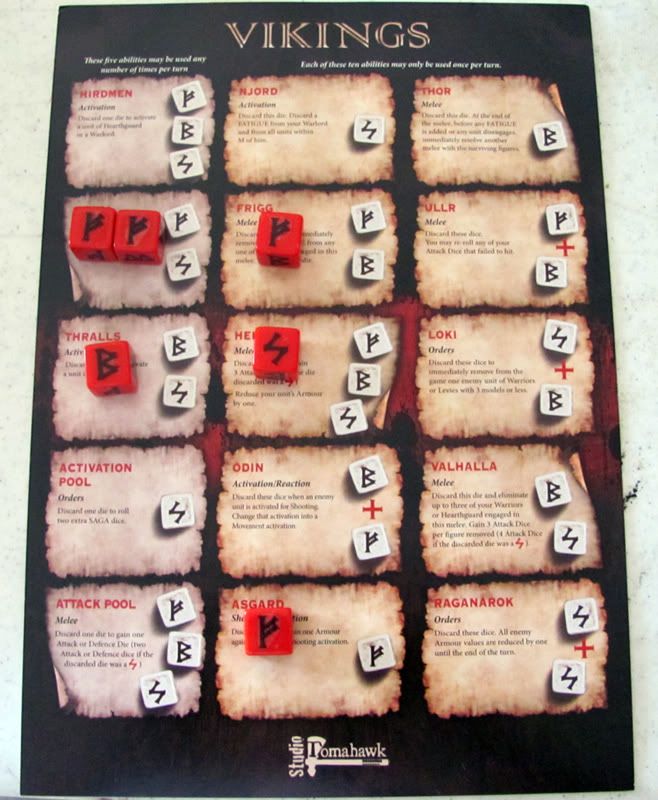
SAGA is super-easy to learn, and it's got one of the most unique mechanics I've seen in wargaming: the Battle Board. At the beginning of your turn, you roll a number of dice equal to the number of groups (or units) of warriors, or hearthguard (elite warriors) you have. Then you add two more for your Warlord, up to a total of 6. These dice are pip less, and instead contain certain symbols depending on the faction you're commanding. My vikings have Fehu as the 1, 2, & 3; Berkana as the 4 & 5; and Eihwaz as the 6. These symbols are then placed on the Battle Board corresponding to the various actions and abilities you can do.  For instance any of the symbols can be expended to activate a Hirdmen (hearthguard), Bondi (warriors), or Thrall (levy) unit, or even the Warlord (who gets one free activation a turn). They can also be expended to do things like roll extra dice, add attack dice at the cost of armor reduction (Heimdal), or reduce all enemy's armor values by one for the whole turn (an umlaut less Ragnarok). Most abilities can only be used once per turn, but others can be used as many times as you have dice to activate them with.

Viking Dice showing all three different symbols.
Though I'm in love with massive, large-scale, wargames, SAGA uses as few as 25 or as many as 73 models for a 6-point warband (your average warband). The majority of my gaming group have been playing with just the pre-built starter kits, which total up to 4 points, but we've taken to this game so hard that we're already looking to expand. You buy your army in 1-point increments. Spending 1 point on your army will buy you 4 Hearthguard, or 8 Warriors, or 12 Levies (your Warlord is free). Now, just because you buy 12 Levies does not mean that these commoners have to run around in a big mob (though it might be better if they did), units can be as small as 4 models or as big as 12. You only get a maximum of 6 SAGA dice (the activation dice I mentioned in the last paragraph), so it might still be a good idea to throw your units into bigger mobs to make sure that all your units (or most of them) are moving and activating in a turn.

4-point Viking warband
To talk a bit about the troop designations themselves: Your Warlord is a big boss; he's you. You command your warband, you get five dice in close combat, you need two wounds in one attack to die, and there's only one of you. Your Hearthguard are your elite units. The Vikings may call them Hirdmen, the Danes may refer to them as Huscarls, the Welsh name them Teulu, but the Normans dub thee Knights. They get two dice in combat, they're harder to kill, and they can be mounted (Normans), or become fur-clad bezerkers (Vikings). The Warriors are known as Bondi by Vikings, Ceorls by Danes, Priodaur by the Welsh, and Sergeants by the Normans. They are your basic warrior. They're easier to kill, only have one die each in combat, but are the mainstay of your forces. The Levies are the commoners; the Peasants (Normans) if you will, or the Thralls (Vikings), Geburs (Danes), or Bonnedig (Welsh). They never generate SAGA dice, they're the easiest to kill, and they only get one combat die for every three models you have in base contact with an enemy. However, there's a ton of 'em, and they are often armed with missile weapons. In fact, unless you're a Norman Warlord and you've given your Sergeants crossbows, they're the only missile weapons you can have in the army.

Combat is also very well-done, representing the defense and push of a group of warriors, while not worrying about what every soldier is armed with, or what each individual one is doing. You total up your dice, and then decide if you're going to stick any of these in defense. Defense pretty much gives you extra dice to throw to resist wounds. You throw a number of dice equal to the number of wounds your opponent caused plus any you stuck in defense in order to "save" and avoid damage. Every success negates a wound. If you decide to play cautiously, you must reduce your attack pool by half (rounding up). For every two dice removed in this manner you get one extra "save" (again, rounding up). This led to a bit of confusion amongst my math-ignored group of gamers, but once you get the hang of it, you're golden!

Game in progress... Though not from my group.

The score required to hit your opponent is determined by their rank in the army, and the saving value is just a 5+, regardless of what you are. Each wound received removes a figure, unless you're a Warlord in which case you need to suffer 2 wounds before you're gone. 1 does nothing (isn't even carried over), and 0 is worse than 1. 3 is pretty good, though.

Alright, enough of that. How did the game actually play out? Excitingly. The Battle Boards give the game a tactical nuance that many "skirmish" games lack. Often, you'll find your skirmish games becoming big scrums in the middle of the board, but with the Battle Boards, your maneuvering becomes more important. You can activate units more than once (though at the cost of adding fatigue counters to the units (which suck)) so how do you position your units to maximize the kerrunch the enemy will feel? Far from creating a boring jockey for position, the Battle Board also gives you special abilities that will help your defenses or your attacks. Each Battle Board is vastly different from each other, as well. The Viking one is very aggressive, giving you extra rounds of combat, or more attacks at the cost of armor, while the Anglo-Danish give you some great maneuverability and versatility in terms of how to use some extra dice you may get.

The game also contains mercenaries and special characters, like the Flemish, pictured here.
Combat is also not a sure thing. The nature of the game is to get into face-smashing range, and hail axes upon your enemies like the frozen rain of the north, but you can't just run in there with no dice on your board. Your enemies might stick their attack dice into their defense and reduce your Valhalla-sending abilities, or they might still have dice on their Battle Board that could activate a reactive special ability, thus luring you into a trap.

Like the aforementioned Flames of War, SAGA comes complete with a pretty big range of figures from Gripping Beast. Because the units are so generic, you can organize almost anything into the various types of the game. Only having to worry about levies, warriors, and hearthguard make it so that you don't have to worry about what type of Hearthguard-looking models you'll need (unless you want to, which is totally cool, and historically nerdy!), just that they look beefy, and are well-armored.

Viking SAGA Battle Board
Now, of course, every game has its bugbears (or jötnar), and this one is no exception. Though my only complaints come from the learning curve of the game, and the speed at which the game travels if you haven't reached the apex of that learning curve. There are a lot of abilities, and you really have to study your Battle Board to get a hang of things. My first game involved me (already with some models) picking up the book, giving it a skim, and throwing down. My first couple turns had longer than average Orders Phase, and at that, I probably only used a quarter of the 15 different spaces on my board. There are also a lot of numbers flying around (though no real math like in games of Warmachine, which is real nice), and a few of those numbers are halved. And why can't gamers remember if halved numbers should be rounded up or down? I think every game designer should have a conference in Geneva and determine whether games (of any kind) will forever round their numbers up or down! In this one they're rounded up, but still...

There you have it! My complaints become null once you get the hang of the game, but even then, this game was ridiculously fun. It's historical in the bigger picture, but it doesn't weigh the game down with pedantry. After only a few skirmishes, this game has placed in my top 10 miniatures games (as you can see to your right), and with good reason. I can't wait to see what kind of campaign material comes out of this system, or even if they go ahead and do a mass-combat variation or (dare I say it?) add fantasy elements. Oh boy! My ax hand quivers with excitement!

+++END TRANSMISSION+++