Thursday, February 10, 2011

Urban War Army Builder Part 2

Now here's something interesting. Instead of posting erratically with up to a month in between posts, I post out of my new schedule a full day after a regularly-scheduled post! I amaze myself.

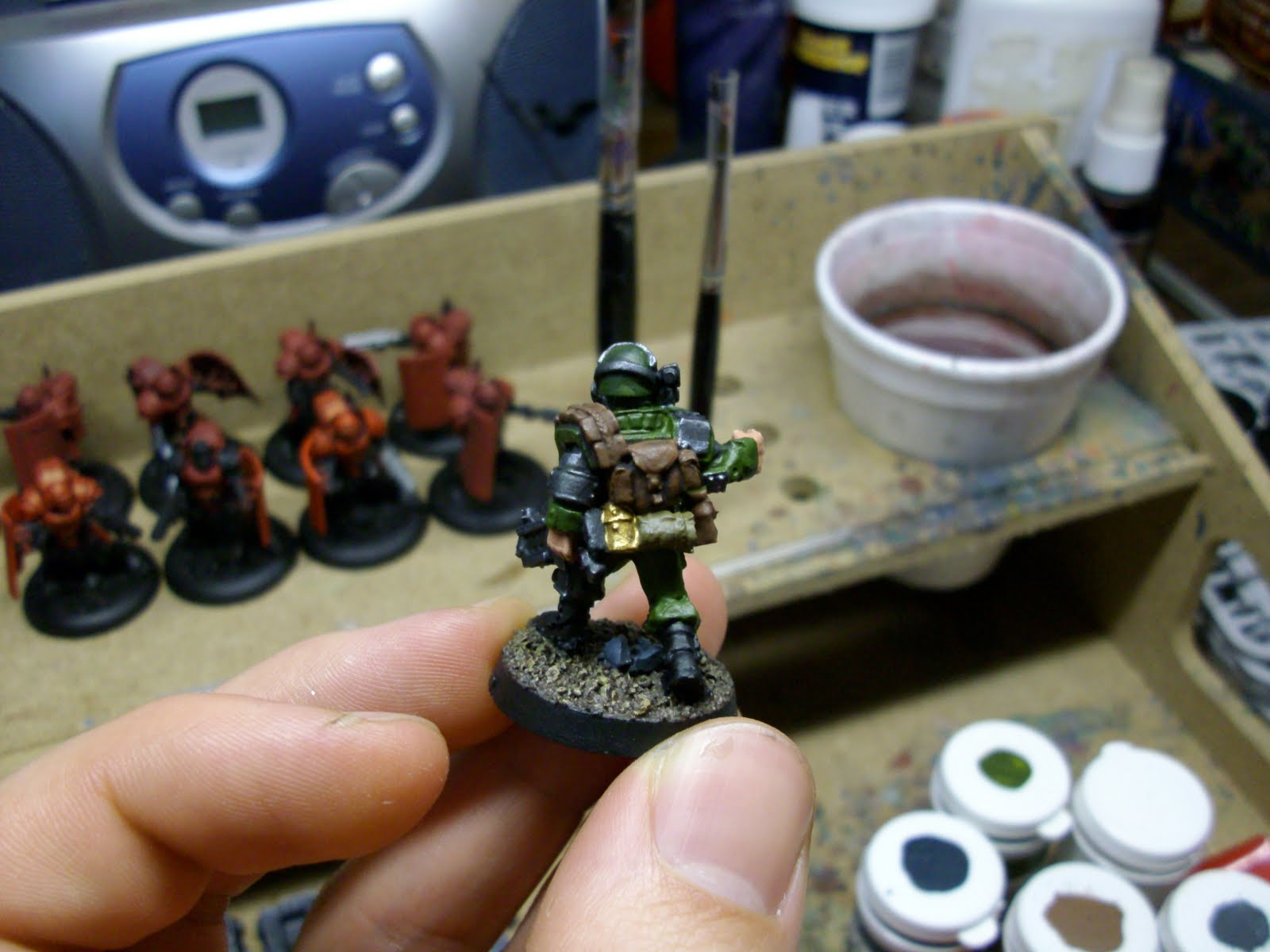
Yes, it's true. The first finished army of 2011! My Urban War Junkers. Bask in their red glory.


So there you have it! The first three pictures are of my 160pt Urban War force, and the last picture is of the whole squad (plus a Flame Thrower guy who goes in another squad and an extra guy) which will form the basis of my Metropolis force. I'm very excited, and I hope I get a game in either this week or next. For my 300pt force I'm adding two Sandrunners, an Exo-Suit, and a Lictor.

You'll also notice that there's some Epic Blood Angels' Rhinos in the background. They are but one color away from being finished, and then no marine shall have to hoof-it! I'm well on track with my Epic painting, but I can't relent. I need to get them done by the end of the month. Not only for the contest I'm in, but in order to keep to my (already jam-packed schedule).

+++END TRANSMISSION+++

Wednesday, February 9, 2011

Hump Day Update (but not in the way you're thinking)

So nothing terribly exciting; just an update.

I'm hoping to finish my Urban War Junkers by the end of the week (for realz!), and get a game in next week. Though, I'm off in Victoria again next week so it might be the week after that. Man! Months are short!

However, I will have a Warmaster Ancients game this Sunday. I'll provide a full report for Monday's post, however it will be woefully devoid of pictures, for my models are, sadly, still unpainted. I've tried to make a larger effort to play with painted figures this year, but my formidable opponent really wanted to get a game in soon, so I relented. It will be 1,000 points using army lists form the Warmaster Ancients rulebook. I'll be using my Imperial Romans and he'll be using his Britons (most of which are naked models, tee-hee!). We broke with the Warmaster tradition of 10mm models and opted for 15mm models based three to a stand, mainly because 15mm ancient models are easier for us to get a hold of.

In other news: Epic fever still has a grip on my group. I'm definitely going to be finished my Epic Blood Angels by the end of this month, giving me 6,000 points of space marines painted (my other 3,000 points is in Dark Angels). A friend of mine is putting together a Baneblade-heavy Imperial Guard list and another friend is doing a White Scars list. To top off the Epic madness, I've received from another friend a rather large collection of plastic Epic Squats! My god! These would be the first Squat models I've ever owned in any capacity. I'm giddy with joy! I went through them this night and I have a lot of figures in those two, tiny, boxes. Unfortunately the metal bits are hard to come by, but I'll keep my eyes open. Though as it stands now, I'm sure I'll have enough plastic figures to do 4,000 points easy.

Probably by Friday I'll have a Junker update as well as the final installment of my series on the Top 5 Roleplaying Games. Next month I'll begin my next series on the Top 10 Miniatures Games.

+++END TRANSMISSION+++

Wednesday, February 2, 2011

Top 5 Role-playing Games: Dungeons & Dragons

Note: The quality of this article is not up to my usual standard. While I don't like churning out schlock, I did on this occasion for the sake of beginning a regular schedule of posting I've been meaning to do for a long time. Paradoxically, I decided to publish a sub-par article for my own good. At the very least I'll get back on a regimen. 
The reason for this sloppy posting is the heaviness in my heart for a friend who passed away February 1st, 2011. Not at all to turn this tragedy towards myself, but I just couldn't muster up the energy to give 100% on this article. Though we weren't terribly close, I've had nothing but great interactions with this man, and I'll miss his presence in the gaming community. 
Adrian Nelson was not only a fellow Vancouver gamer, but a kind and fun person who succumbed to health problems too soon. A gamer, actor, and Viking enthusiast, he will be missed by everyone in the Lower Mainland who pushes 10mm fantasy and historical soldiers around on the tabletop. My condolences go out to those who knew him better, and to his family. 

Now here’s a classic. If you’ve never played Dungeons & Dragons (D&D) before, then you’ve definitely heard of it. It was the first role-playing game and it’s still as great today as it was 35 years ago. Currently the game is in its 4th edition, and while it’s drawn a lot of controversy I do believe that it’s the best game to bear the D&D logo.

I began my foray into D&D during the mid-90s during its 2nd edition. Back then it was called Advanced Dungeons & Dragons 2nd Edition (AD&D2E) and it was done by a man named David “Zeb” Cook, who, as far as I know, isn’t doing any games design these days. The game represented mystery to me. I had always heard of this game, but I had never played it, and wanted to see if it was as dangerous and Satanic as the public made it out to be. It wasn’t, of course, but it was very mysterious, and seemed endless in its possibilities.

You see, the D&D books presented no particular world; it was all just generic fantasy art, and concepts. Sure they had settings like Greyhawk, the Forgotten Realms, and Dark Sun, but the idea behind D&D is that the game is a toolkit that you can use to create your own fantasy world.

Without getting too much into the mechanics of the various editions (they’re all similar in many regards, and I’m not familiar with the earliest editions of D&D), I’ll explain how the game works: It uses all of the basic polyhedral dice (d4, d6, d8, d10, d12, and the ubiquitous d20). One would roll a d20 to resolve most actions, trying their best to roll as high as you could (though low rolls were sometimes desirable in the earlier editions). In D&D4 you roll a d20 and add any modifiers based on your skills, then compare to a certain defensive number of your target, or to a number set by your Dungeon Master (DM) in the case of skill checks. Then on a successful attack, you’d roll your damage dice (each weapon or attack possessed a different die).

After AD&D2E Tactical Studies Rules (TSR), the owning company of D&D went bankrupt. The reason cited for this is that they overextended their novel publishing arm and during a year of very bad sales, were forced to refund the book chains the money paid for the books. Wizards of the Coast (WotC), the makers of Magic: the Gathering, bought TSR’s stuff for $1,000,000 (all of this info is courtesy of the D&D coffee table book). WotC had the foresight to keep D&D alive, despite dwindling sales of RPGs at this time (mid-to-late-90s), and in doing so save an industry.

In this gamer’s humble opinion, the d20 license saved role-playing. Many have claimed that it created a homogenous industry, but I think that’s ascribing the d20 system to the natural decline of many role-playing games at the time. In 2000, WotC re-did D&D for the 3rd edition. They dropped the “Advanced” off the title, and made the rules free for any developer to use and create their own games (called the Open Gaming License (OGL). This was the shot in the arm that created many games companies that are around today, gave us some great titles, and gave some older titles a second life. Games like Deadlands, and Cyberpunk saw reprints in d20 form, while games like WarCraft, or Conan: the Barbarian saw pen-and-paper versions for the first time. Now many games companies have sprung back from the days when everything used the D&D3 rules, and the license is not as common as it was ten years ago, but the industry is healthier because of it, and now many other companies aren’t afraid of opening their doors to other publishers to use their mechanics (Savage Worlds, FATE, etc).

In 2008 the D&D3 system had grown too big and unwieldy. What was once a clear and concise game had its boundaries blurred, so that wizards and fighters were little different than each other. What the industry needed was a shot in the arm again, and in order to break away from the homogeneity that it helped create, D&D4 was established. D&D4 is a more dynamic and cinematic game system. It definitely takes some cues from the video gaming industry, which is reaching Hollywood-ish proportions. In a form of true reciprocity, D&D borrowed from the very industry that borrowed from it. As a result D&D4 just has more for you to do! There are more options during character creation, and combats are more dynamic, with more movement, and more description. No longer do you sit there and stab the Gnoll with your sword; instead you’re taunting that Gnoll so that its attacks are directed away from your friends, whose attacks are bolstered by your other companions, all so the rogue in your party can slash at the Gnolls legs, not only causing damage, but hamstringing the poor creature as well.

Now, of course this game is critiqued as being too much like a Massively-Multiplayer Online RPG (MMORPG, or just MMO). But as I stated before, it’s only borrowing from something that it helped create. D&D is growing, and it needs to. Sure RPGs are not in the danger they were in ’97, but that’s not to say that the industry is invincible. Companies like Fantasy Flight Games are creating RPGs that are hybrids with other forms of gaming (Warhammer Fantasy Roleplay 3rd edition), while the “Indie” role-playing market (which celebrates more esoteric game mechanics) is rather big and desired by many role-players. And if I may be so bold, I believe that D&D4 is more faithful to the original D&D than the previous two editions, which tended to bleed the various player classes into one another. In this edition, a rogue is a rogue, and a wizard is a wizard, and there’s no mistaking a cleric for a druid, or a barbarian for a fighter. Each has their own roles that they play within the party, and help to create these great synergies, which make playing this classic game all the more exciting.

In short, D&D is one of my favorite role-playing games of all time. While the newest edition is my favorite, the previous games each had their charm, and I had fun playing the previous two editions that I had. After all, I wouldn’t have played them for the twelve years before D&D4 that I had if I didn’t like them.

+++END TRANSMISSION+++ 

Tuesday, January 18, 2011

Urban War Army Builder

Alright, so four of us in my game group decided to work on some Urban War forces from Urban Mammoth.

I'm doing the Junkers
Another is doing Gladiators
The third is doing Viridians
And the fourth is working on Syntha

So far we've all got our figures, and two of us have our rulebooks, and two of us have started painting. Here are the photos:


Syntha
From Urban War Builder Campaign

Here's a Gladiator test figure
From Urban War Builder Campaign

Here are some of my Junkers:
The Test Figure
From Urban War Builder Campaign

My incomplete squad
From Urban War Builder Campaign

The Viridian player hasn't completed any figures yet.

Stay tuned for more on this exciting challenge! This week I'm going to Victoria, BC to visit my girlfriend, where I will paint my Epic Blood Angels while she's at school, and hopefully finish a vast majority (if not all) of my infantry. Next week I'll work on my Urban War figures some more, and bother the other two contestants in order to get some work and/or photos from them. Also, I got the rest of my VOR Union army in the mail today. They're all there, and they look like really good sculpts! Great quality and tons of venting, which leads me to believe that these were recent castings.

Anyway, I'll work on the VOR figures some more soon, and let the blog know about it ASAP.

+++END TRANSMISSION+++

Friday, January 14, 2011

An Update

Yes the "Whatcha workin' on?" widget at the bottom of the right column (right above the tags) is correct; I am currently working on all of that. And I'm sick. Hoorah!

I promised myself that I wouldn't get distracted by the next shiny object™ while working on my Dark Eldar. Well, it turns out I've been distracted by four older shiny objects.

Yes, I've been caught up in VOR fever, ever since the Kickstarter Project was announced. I have a Union army on the way, and one squad base-coated (see last post). I've also been caught up in Epic fever (more like a disease that stays with me always), and am working away at a Blood Angels army. I've been very slow in getting those pictures up. I think I'll just wait 'till the whole project's done, then snap some shots.

Finally two 28mm games that are separated by circumstance: Warzone and Urban War. I'm in an Urban War builder campaign with some friends. I'll post some pictures of my Junkers soon, I've just been waiting for the rest of my friends to catch up with me. I'm pretty quick with my figures, and since I only have seven of them in my 160pt. force, I shouldn't take too long with them. Warzone, on the other hand I've decided to spring on my boss as a challenge. When I got home and wrote up a 500pt. 2nd edition list, I noticed that I actually need to paint 16 models! Not a huge number by any means, but when you have four other projects on the go, it's a little much. Thankfully I don't think we're in a rush to get some games in. Warzone is in my top 3 TTG list, but really this game we have tentatively scheduled is a placeholder for Dark Age, which is taking its sweet time getting their book(s) out. Of course, we'll play 2nd edition Warzone, it being my favorite. I'll post more about it as it happens.

All-in-all, I'm busy. But there's a light at the end of the tunnel. My Urban War shouldn't take too long to paint, and seeing as I'm in a paint challenge on Tabletop Gaming News' forums with my Epic figures, those should be done by the end of February. I still have a ways to go on them, but I can pull it off. That should take some heat off me and hopefully no new shiny objects™ will jump out at me.

+++END TRANSMISSION+++

P.S. Plans for the coming week: I'm going to write installment 4 of the Top 5 Role-Playing Games segment; I'll get some Junker photos up; and I'm going to Victoria to visit the girlfriend and work on some Epic figures while she's at school.

Friday, January 7, 2011

Test Figure for a VOR: the Maelstrom Army


Cross-posted from the VOR: the Maelstrom 2.0 forums. I don't know why some of the text is highlighted a whitish-grey. I've tried to fix it a million times, and it seems that every time I hit "publish post" some new line of text is highlighted. Really sorry for the inconvenience. If I figure something out I'll implement it.


"Oh. Kay. 


I did some painting this week on a test figure, which is a Union sergeant. Before I paint an army, or embark on a project of that magnitude, I find that it helps if I work on a figure to completion to see if the colors work well together or if there's any pitfalls to painting those figures. So far, I've not had to do any major re-calibrations of paint schemes in my time, but a test figure helps me work out any kinks along the way. 


Some minor details may change, but here's the test figure. The only things not finished on him is the base (I'm gonna put some static grass on him), and the green fatigues are only base-coated. The reason for this is that I used the P3 paint Ordic Olive and I don't actually own any of the recommended highlight colors (Moldy Ochre, and Sulfuric Yellow). This should be remedied by next Wednesday, but in the mean time I think I'll just go ahead and finish it tomorrow with what I have on hand (I think with a total of five different paint lines, I'm sure I'll find something to substitute). With some more work I might even enter this into the paint competition on the forums here.


The paint scheme is taken as best I could from the Matt Wilson cover art of the Union forcebook. I'm a big fan not only of Matt Wilson, but of that piece of art as well.


Before I get to the breakdown, know that when I highlight I generally mix in the highlighted color into the previous color or color mixture. For example when I highlight a dark red, I'll mix in a medium red; paint it on, then mix in a light red into that mixture, then paint that on as the final highlight. I tend not to just paint a lighter color over top. 


+The fatigues are Ordic Olive (P3).


+The metallics are Shadowed Steel (Reaper Master Series (RMS)), followed by a wash of Badab Black (Citadel). I'm actually gonna do some highlights later with Honed Steel(RMS), then perhaps Polished Silver (RMS) if it's not too bright.


+The blacks are Thamar Black (P3), then some Coal Black (P3) mixed in for a highlight, then finally some Menoth White Base (P3) mixed in for the final highlight.


+The browns are Bootstrap Leather (P3) with a Devlan Mud (Citadel) wash. This might become a Calthan Brown (Citadel) with a Dheneb Stone (Citadel) highlight, then a Devlan Mud (Citadel) wash.


+The little bedroll on his back was just Thornwood Green (P3). I'll probably just highlight it later. I don't imagine I'll wash it. It might end up too dark.


+His skin was Idrian Flesh (P3), then Khardic Flesh (P3), then Midlund Flesh (P3), then finally Ryn Flesh (P3). Doing faces and skin is my favorite part of a figure, and it's something I think I'm pretty good at. I've tried washing skin and haven't found a wash or an ink that I like for flesh. They often end up just darkening it more than I'd like. The fact that I start with something dark like Idrian Flesh and then paint right over top of it with the base skin color I want (like Khardic Flesh) gives it that definition without darkening the whole thing. 


+Finally the base is (aptly enough) Battlefield Brown (P3) with a Gun Corps Brown (P3) highlight drybrushed right over top (no mixing), and finally a Rucksack Tan (P3) done with the same method as the last highlight. The rocks are Greatcoat Grey (P3) with a Morrow White (P3) highlight that had some of the base color mixed into it. Green static grass will get added when the model's 100% done.


+I've gotten into the habit of painting the rims of my bases black (Thamar Black (P3)). My boss isn't that keen on it, but I like the way it looks. It makes the figure look less like he's on a mound of dirt/grass/rubble/etc. and more like the base is just there because he can't realistically stand on the tabletop. It's hard to explain my aesthetic rationale behind it. Hopefully you understand. 


Sorry for the crummy photography. I have a cheap-o camera that doesn't do macro very well at all. These two are the best of 20 photos. Seriously. Hopefully you get the drift. I had tons of fun painting this fig, and can't wait to get to the rest of the army (when it arrives from IWM)."

+++END TRANSMISSION+++

Monday, January 3, 2011

Top 5 Role-playing Games: Savage Worlds

For the third entry in this series (again, this goes in no particular order), we have Savage Worlds: a game I was, at first, hesitant to play.

Savage Worlds is an open-source Role-playing game (which means that it's a set of rules you can use with any setting) produced by Pinnacle Entertainment Group and Studio 2. When this was first brought up as a game idea, our group had just finished playing Dark Heresy. This would've been when Dark Heresy was first released, and Savage Worlds (SW) would've been a huge departure from our safe haven of gaming that included only Dungeons & Dragons and the Warhammer/40K gaming system(s). I was hesitant not only because it was different (my gaming pioneer spirit was somewhat limited then), but because it seemed too simple. Now I know that's where its beauty lies.

We're three sessions into our SW gaming right now, and this game easily squeezes into my top 5 gaming list. Its simplicity does nothing to limit its entertainment or depth, and is indeed the only way that SW can integrate so many different genres and worlds under its banner.

Savage Worlds is a role-playing system that mixes roleplaying with miniatures gaming. If I'm permitted to blow your minds, I'll suggest that SW makes as entertaining a miniatures game as it does a role-playing game. The system uses all of the standard polyhedral dice save the d20 (we've seen enough of that one!), and uses them in conjunction with the French deck playing cards (something I generally hate) to resolve all uncertainties in the game.

All your vital statistics and skills are represented not by numbers but by dice. For instance my current character (a Duwamish marksman who went AWOL during the First World War) has the following attributes: agility (d8); smarts (d6); strength (d4); spirit (d6); and vigor (d8), while for skills he has a d10 in shooting, but only a d4 in fighting, and so on. 

When rolling to do something you roll the die that the skill uses (or if you're rolling a straight attribute roll, you would roll the die associated with the attribute), plus a d6. The extra d6 is something that player characters (PCs) get as well as some non-player characters (NPCs). If you get this extra d6 you're considered a Wild Card (even NPCs can be wild cards). Anyway, roll your skill/attribute die plus the d6 and choose the highest roll. If you roll the maximum allowed on a die (the number next to the "d") you get to roll again and add the value to that die roll so long as you keep rolling maxes. If the highest roll is greater than 4 (the Target Number (TN)), you succeed. If you beat the TN by another 4 you get a "raise" (get the poker terminology yet?) which is like a level of success in the Warhammer 40,000 RPG.

Damage is as simple as rolling the damage value of your weapon and applying it to the target's toughness and armor combination. If it beats it, he/she/it's stunned, if it beats it again he/she/it's wounded once. You get three wounds before you're incapacitated, and it's game over, rover. Each wound level (-1, -2, and -3) reduced every roll by that number. Oh! Before I forget, it's also important to know that most modifiers to rolls come in the -/+2 value. This will reduce or increase your roll not the TN, which remains always at 4. 

That easy. Now the poker terminology comes from the fact that this game is a modified version of the old Deadlands RPG which was done by this very same game company during the '90s. Deadlands is still around and is the flagship setting for SW (which is, itself, open-source and can be used for any setting you can dream of). Deadlands is the wild west gone mad: undead, native magic-users, crazy Victorian inventions, and a never-ending civil war that turns the western genre on its head. I'd love to run this game sometime.

Currently we're playing in a "pulp" setting: 1936 America. One character is a more hard-boiled Indiana Jones, another is a 1930s Iron Man, and the third just got back from a gaming break for the holidays and will be "rolling-up" a character tonight. We're playing adventures from the first Daring Tales of Adventure compendium, and having a blast. So far, there have been no rules disputes, and if there's any rules questions, the answers are easily found in the book.

Savage Worlds is meant to be used with miniatures (a standard in RPGing these days if you ask me), and breaks from the standard grid-mat trend and introduces inches and terrain (something that convinces me this would be great to play a miniatures game with). You can use a grid mat if you like (I prefer hexes), and we use an abstract tabletop (we use miniatures, and terrain but don't measure anything and just use the figures for visual aids), but the rules take into account tabletop features. 

Now while this game is fantastic, if you're looking for something deeper you might want to try Rolemaster, or its sci-fi sister Spacemaster. Savage Worlds is a light game, but my opinion on RPGs is that all rulesets are combat systems, and the role-playing and the depth are left to the Game Master and the group. If you want to figure out how much damage was done to an NPCs arm, and what kind of diabolical poison comes from crushed Ghan'ka root, you should probably find a translated version of Das Schwarze Auge (or learn German). Unless you want to reduce that detail to a -2 roll. 

Overall, Savage Worlds is a fantastic game system, and my brain is filled with ideas for using it to run everything from a RPG set in the Vor: the Maelstrom universe, a Deadlands game, or even using it instead of Mutant Chronicles. Yes, this game is firmly entrenched in my top 5 role-playing games.

+++END TRANSMISSION+++

Friday, November 12, 2010

Delay

Hey all!

Sorry about the no-post on Wednesday. The Internet was wonky, and then the file I was working on didn't save. You'd think I'd know better after writing essays for six years straight in university!

Anyway, Thursday's just not in the cards so here's an apology post with a promise that Friday night I'll get something up. Think of it this way: you can read about the next role-playing game on my list while you munch on your morning grapefruit. Because those things are munch-able.

Man, I'm tired.

+++END TRANSMISSION+++

Monday, November 8, 2010

Epic Dilemma

A bit of a spoiler for the forthcoming Top 10 Tabletop Miniature Games series I'll do after its Roleplay cousin wraps up, but my favorite wargame of all time is the Epic series by Games Workshop. Ever since I was 11 and Epic 40,000 was released I was hooked. Afterwards when I did some research into the previous editions of Epic (Adeptus Titanicus and Space Marine 1st edition, then Space Marine 2nd edition and Titan Legions), and experienced the pinnacle in 6mm gaming with Epic Armageddon (the most recent Epic edition) I came to realize how simplistic Epic 40,000 was. But none the less it occupies a special place in my heart.

Now, Epic Armageddon may be a solid, and ingenious gaming system, in my eyes it is incomplete. Why Games Workshop decided that the first supplement, Swordwind, should contain yet another Imperial Guard and Ork army list and not decide to do updated Chaos Space Marine, and Tyranid lists is beyond me, but alas Specialist Games imploded shortly after the release of Swordwind, thereby leaving out two armies that have models. 

Recently when I got the bug to start playing Epic again, I looked at Epic Armageddon, and realized that the Tyranid player in my group, and the Chaos player would be high and dry when it came to army selection. This began a search for a different system that could satisfy our 6mm gaming needs. Epic 40,000 was (as described previously) too simplistic, and one gamer even refused to play it. This left us with NetEpic.

NetEpic, I haven't played. However, from what I understand it is the old Space Marine/Titan Legions rules updated after ~7-8 years of playtesting by fans. The selling point is the full-color rulebooks they offer as free .pdf downloads. I passed the word around and now we're going to give it a shot. 

I've spent the last couple of days reading the rules and building army lists for my Blood Angels and I think after a few paint sessions I should be ready to go. We have access to fantastic Epic-scale Forge World terrain and everyone has a painted force. I'll let you know how it goes closer to our playing. I think it's still some time off, but I'm excited to give this new/old ruleset a shot.

In other news: In case I didn't mention it before I'm doing the posts for the Roleplaying List once a week (on Wednesdays), and when it's over and I start doing the Wargaming one, I'll do it twice a week (Mondays and Fridays) mostly because there will be 10 games on the list instead of 5.

Sorry if this post seems disjointed, or all over the place. I'm in between projects right now, and I'm quite tired. After I scribe this, it's time to clean the house, then prepare for Vampire: the Requiem tonight.

+++END TRANSMISSION+++

Friday, November 5, 2010

Top 5 Roleplaying Games: Warhammer Fantasy Roleplay

To continue the series on what I believe the top 5 role-playing games of all time are, I hereby give you: Warhammer Fantasy Roleplay.

Much like the Warhammer 40,000 Roleplay system (of which I wrote in the first installment), this is a dangerous game, where one cannot simply walk into a room of orcs and begin swinging safely, nor can you discount the effects of madness, or disease. Very few healing potions will save you from Nurgle's Rot, or the sight of watching your friend's leg get hewen from her body.

Remember what I said in the preamble to this series: These games are arranged in no particular order, otherwise this would be last in the series taking it's rightful place as what I believe to be the best roleplaying game I've ever played. Also remember what I said about editions. When I mention a game I take into account all of the editions I have played, in this case it's all of them.

I began my first foray into Warhammer Fantasy Roleplay (WFRP) during the years when Hogshead took over production of the game. This was in the early 2000s, and during that time the Games Workshop in Metrotown Centre (which was my game shop of choice) actually carried the books. Apparently they didn't sell exceptionally well, but I bought every, damned, book they had over time. i had dabbled in Advanced Dungeons & Dragons 2nd Edition previous to WFRP, but never had I dove into a game with such enthusiasm as WFRP 1st edition. Perhaps it was my already well-grounded love for the Warhammer World through the fantastic miniatures game, or perhaps it was the fact that while AD&D 2E was fun, WFRP promised to be a dangerous and brutal game that would tax my decision-making skills in ways that dungeon crawling never had.

+ENEMY WITHIN CAMPAIGN SPOILER ALERT+
I began Game Mastering (GMing) the Enemy Within Campaign (even today hailed as an amazing campaign by critics, and the most fun I've ever had playing an RPG). The Enemy Within took the players on a quest from Bögenhafen near Altdorf, all the way to Kislev and back to confront a Greater Daemon of Tzeentch and save the Empire. Though the time in Kislev was a bit tedious and strayed from what is now believed to be absolute canon of the Warhammer World, the dark humor of the stories and the recurring characters made you feel totally immersed. If you're looking for a sentence to sum up the greatness that this campaign and game possessed: WFRP 1st edition and the Enemy Within Campaign kept a group of four 9th graders playing every week for the entire 5-volume set.
+END OF SPOILERS+

Then in 2005 during my time working as a redshirt at the very Games Workshop where I first experienced WFRP, Black Industries was founded. This subdivision of Games Workshop was to deal with Games Workshop's board and role-playing games, though the rules were developed by the ever-creative Chris Pramas and the folks at Green Ronin Publishing in Seattle. Green Ronin created the 2nd edition of WFRP; tidying up some of the loose ends and clarifying bits here and there, but overall not changing much. To a gamer like myself (who hadn't sojourned across the Old World in over four years) this was perfect. Now more people could experience what I and my three friends did back in high school. The big campaign was called Paths of the Damned, and was a three-part series that advanced the WFRP timeline to the current events of the Warhammer World: The Storm of Chaos.

In 2008/2009 the reigns of board and role-playing game publishing went to another American outfit called Fantasy Flight Games (FFG), a company who had made other forays into role-playing but was most famous for its boardgames. Fantasy Flight soon announced another edition of WFRP, and this time it would be different again from other role-playing systems. This time it was to have board game components. This news shocked the role-play community (gamers are a fairly conservative group), and I must admit even shocked myself.

As a clerk at a games shop I got a complimentary copy from FFG and I ran the intro adventure in it for a group of gamers. While skeptical at first, it quickly grew on me. I realized that what I loved about WFRP wasn't the percentile dice, or the critical hit charts, or the miniatures (though all those things were great), but that I loved the grittiness, the danger, and the insanity. The third edition (though adding cards, symboled instead of numbered dice, and counters) was exactly what the other editions were, but more innovative.

So how do the games work then? Well, the first two editions are similar, but the third isn't really, so I'll do them in two groups.

1st/2nd Editions
To begin you'd roll d10s and add a modifier for each statistic, which were similar to the Warhammer Fantasy Battle statistics: Weapon Skill, Ballistic Skill, Strength, Toughness, Wounds, Leadership, Intelligence, Willpower, and Dexterity. Then you'd choose a race and a class (Elf, Human, Dwarf, or Halfling; Warrior, Academic, Priest, Rogue (classes were gotten rid of in 2nd edition)). Then you'd roll a d100 on a career chart (or a specific career chart as determined by your class in 1st edition), and cross-reference your roll with your race and get your career. This would describe what you did before you became an adventurer.

The game was d100 based with low-rolls being better than higher ones. You'd want to roll under your characteristic to succeed, then for damage you'd roll a d6 (in 1st edition) or a d10 (in 2nd) and add the first digit of your strength (or the Strength Bonus in 2nd edition, which was the same thing as in 1st, it just got its own entry on the stat line), subtract the Toughness and armor of the opponent and that's how many wounds you'd do. If your opponent's wounds got to below 0, you'd roll a d100 on a chart, cross-reference the amount that the damage brought the opponent below 0 by, and get a result which you'd look up on a chart. Also, the game was location-based, so you could hit someone in the arm, head, whatever.

The magic systems were the most different in the two editions: In 1st it was more like Warhammer Fantasy Battle 3rd edition where your character would have a certain number of magic points that would decrease with spell use and increase with rest. Almost like a currency. In 2nd edition, you had a magic number which would be the number of d10s you had to roll. If any of them turned up a 9 (Tzeentch's favorite number) you'd roll on a specific chart depending on how many 9s you rolled and see what your penalty is. Magic in 2nd edition was more in line with Warhammer Fantasy Battle 6th edition, and was, thus, more dangerous. I liked the 2nd edition way of magic better.

3rd Edition
3rd Edition still has the careers, still has the critical hits, and still has the insanity, but they all work a little differently. The characteristics are point-buy instead of rolling (because in this edition there are no numbered dice, only ones with symbols). Then you'd choose your career card, and choose your talent, and action cards. Talent cards fit into your career sheet like slots, with each sheet having space for a certain number of talent cards, and the action cards are ones you're trained in, or have the requirements for. The dice mechanic is much better than in the first two editions, and it goes like this.

Take the number of blue d8s based on your characteristic, and add any white d6s if you have a bonus to your characteristics. Then add a number of purple d8s equal to the difficulty. Then you must convert a number of blue d8s into either red d10s if you're reckless, or green d10s if you're conservative (as determined by choice, and career). If you have any pertinent skills, add a yellow d6, and then add white d6s for favorable environments/situations and/or black d6s for unfavorable ones.

Then roll. Certain symbols cancel out others, and others just stay there. You're able to succeed, and still have bad things happen, as well as fail, and have good things come out of it. Personally, I believe this mechanic helps role-playing as opposed to hindering it. In games with numbers, it's easy to just say "I hit" and move on. This way, you're forced to describe the scene to make sense out of why you can succeed but still have bad luck. "As you stab into the beastman, he slips on the blood of his comrades, wrenching the sword out from your hand and falling to the ground just as the minotaur bounds towards you."

The game also takes miniatures and battle mats out of the equation. Weird, especially with the fantastic range of figures Citadel Miniatures has. However, this makes the role-playing the center of the action and the exact placement and fiddly details of maps gets pushed aside. Criticize the game all you want, but you can't say that role-playing is limited in favor of a 'board game aesthetic.'

Overall, I love the new edition (possibly the best). It definitely adds more to the game table (which isn't always good), but the to-hit ratio is greater, and it still retains all the bits of the last editions that I loved. That being said, I wouldn't have played the last editions for nine years if they weren't brilliant either, and so I shouldn't say that the new edition blows the others out of the water, but that it adds to them to help make WFRP the best roleplaying series I've ever played.

+++END TRANSMISSION+++